
Many people assume that a standard driving licence is all you need to operate a taxi in Edinburgh. This misconception can lead to serious legal trouble and safety risks. In reality, taxi driving requires a specialised local taxi licence issued by Edinburgh Council, separate from your ordinary driver’s licence. Understanding the licensing requirements is essential whether you’re an aspiring taxi driver, a business owner needing compliance, or a resident wanting to know what protections exist. This guide explains what a local taxi licence is, how to obtain one, the key regulations you must follow, and why proper licensing matters for everyone in Edinburgh.
Table of Contents
- What Is A Local Taxi Licence In Edinburgh?
- How To Obtain A Local Taxi Licence In Edinburgh: Requirements And Process
- Understanding The Difference Between Local Taxi And Private Hire Vehicle Licences
- Why Local Taxi Licensing Matters For Edinburgh Residents And Businesses
- Discover Expert Taxi Services And Licensing Help With Capital Cars
Key takeaways
| Point | Details |
|---|---|
| Legal requirement | A local taxi licence is a mandatory permit issued by Edinburgh Council to regulate taxi operations and ensure passenger safety |
| Strict standards | Applicants must meet driver background checks, medical examinations, and vehicle inspection requirements |
| Taxi vs private hire | Local taxi licences allow street hails and rank pick-ups, whilst private hire licences require pre-booking only |
| Community impact | Proper licensing protects passengers, ensures fair competition, and maintains Edinburgh’s transport standards |
What is a local taxi licence in Edinburgh?
A local taxi licence is a legal permit issued by Edinburgh Council that authorises you to operate a taxi within the city’s jurisdiction. This licence exists to regulate the taxi trade and protect public safety through rigorous oversight. Local taxi licenses are mandatory permits issued by councils to regulate taxi trade and ensure safety standards in the UK, forming the foundation of Edinburgh’s transport infrastructure. Without this licence, driving passengers for hire is illegal, regardless of your driving experience or vehicle quality.
The licensing system serves multiple critical purposes beyond simple paperwork. It ensures that every taxi driver undergoes thorough background checks, including criminal record disclosures and medical fitness assessments. Vehicle inspections verify that taxis meet safety and accessibility standards before they enter service. These measures create a framework where passengers can trust that their driver is vetted and their vehicle is roadworthy.
A local taxi licence differs fundamentally from both your standard driver’s licence and a private hire licence. Your ordinary driving licence proves you can drive legally on public roads. A local taxi licence proves you meet additional professional standards for carrying paying passengers. The distinction matters because taxi work involves unique responsibilities, from fare calculations to passenger safety protocols that regular drivers never encounter.
“Proper taxi licensing creates a professional transport sector where safety, accountability, and service quality are non-negotiable standards rather than optional extras.”
Edinburgh’s local taxi licences typically cover several vehicle types:
- Traditional black cabs and hackney carriages
- Wheelchair-accessible vehicles meeting mobility standards
- Saloon cars and estates approved for taxi use
- Larger vehicles including 6 to 8-seater carriers for group transport
Each vehicle type must meet specific council requirements for insurance, signage, and equipment. The Taxi UK licensing guide provides comprehensive details on these standards. Understanding what your licence covers helps you operate legally and avoid penalties that could jeopardise your livelihood.
How to obtain a local taxi licence in Edinburgh: requirements and process
Obtaining your local taxi licence in Edinburgh involves a structured application process through the council’s licensing office. The journey from application to approval typically takes several months, so planning ahead is essential. Here’s the complete process broken down into manageable steps:
- Contact Edinburgh Council Licensing to request application forms and guidance documents
- Complete driver eligibility checks including age verification and licence history review
- Submit to background screening through Disclosure Scotland for criminal record checks
- Pass a medical examination conducted by an approved doctor to verify fitness to drive professionally
- Prepare your vehicle for inspection, ensuring it meets all council specifications
- Attend vehicle inspection at the designated council testing facility
- Pay application fees covering processing, inspections, and licence issuance
- Receive provisional approval and complete any required training programmes
- Obtain final licence and display it correctly in your vehicle
Driver requirements form the foundation of your application. You must be at least 21 years old and hold a full UK driving licence for a minimum period specified by the council. Applicants must meet strict driver and vehicle standards, including medical checks and background disclosures, to obtain a taxi licence. Your driving record will be scrutinised for endorsements, with serious offences potentially disqualifying you. The medical examination assesses whether you have conditions that might impair your ability to drive safely for extended periods.
Vehicle requirements ensure passenger safety and comfort standards. Your taxi must typically be less than a specified age limit, often around 10 years for initial licensing. The vehicle needs a current MOT certificate, comprehensive insurance specifically covering taxi use, and compliance with accessibility regulations where applicable. Council inspectors examine everything from seatbelt functionality to meter accuracy during the roadworthiness test.
Important paperwork includes:
- Completed application form with accurate personal details
- Proof of identity such as passport or birth certificate
- Proof of address through utility bills or council tax statements
- Driving licence photocard and paper counterpart if applicable
- Vehicle registration documents and insurance certificates
- Medical certificate from your examination
- Disclosure Scotland certificate showing your background check results
Application fees vary but typically range from several hundred to over a thousand pounds when you factor in medical exams, background checks, vehicle inspections, and the licence itself. Budget for these costs upfront to avoid delays. Understanding local taxi licence application tips helps you navigate the financial aspects smoothly.
Common pitfalls include submitting incomplete applications, failing to disclose previous convictions, using vehicles that don’t meet specifications, and missing renewal deadlines. Each mistake can delay your application by weeks or months.
Pro Tip: Start your application at least four months before you need to begin work. This buffer accommodates processing delays, allows time to address any issues that arise, and ensures you’re not losing income whilst waiting for approval. Keep copies of every document you submit and maintain a checklist tracking each requirement’s completion status.
The distinction between taxi and private hire licensing often confuses applicants. Knowing the private hire taxi legal differences prevents you from applying for the wrong licence type and wasting valuable time and money.
Understanding the difference between local taxi and private hire vehicle licences
Edinburgh operates two distinct licensing categories for passenger transport, each with specific operational rules and legal requirements. Understanding these differences is crucial whether you’re planning to drive, operate a transport business, or simply want to know your rights as a passenger.

A local taxi licence, also called a hackney carriage licence in some jurisdictions, grants the broadest operational freedom. Licensed taxis can pick up passengers who hail them on the street, wait at designated taxi ranks throughout the city, and accept pre-booked fares through phone or app services. This flexibility makes taxi licences highly valued but also more strictly regulated. Taxi drivers must use council-approved meters for fare calculation, display their licence plates prominently, and often face vehicle age restrictions to maintain fleet standards.
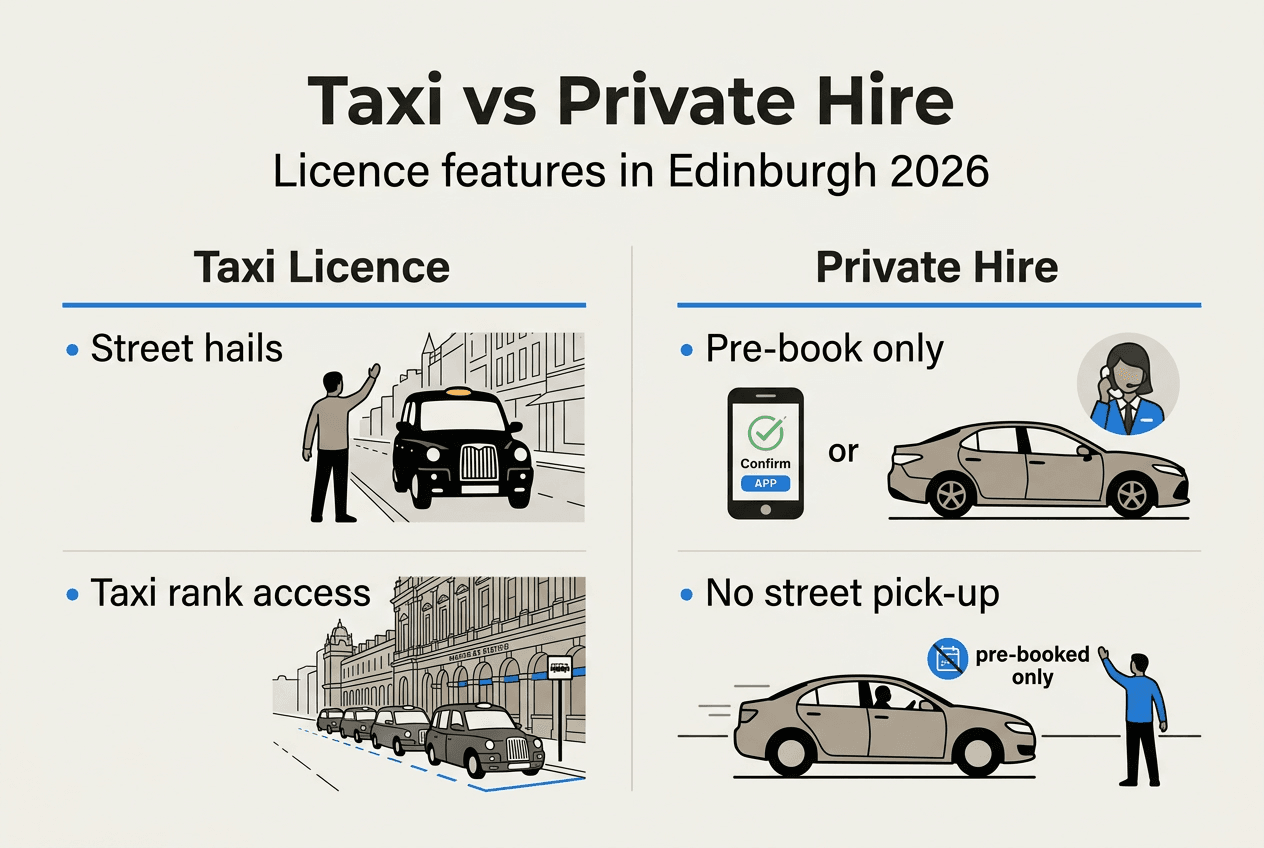
A private hire vehicle licence operates under different constraints designed for pre-arranged transport only. Local taxi licenses allow street hail and taxi rank pick-ups, whereas private hire vehicles require pre-booking and different licensing conditions. Private hire drivers cannot legally pick up passengers who flag them down on the street or wait at taxi ranks. Every journey must be booked in advance through an operator licensed by the council. This booking requirement fundamentally shapes how private hire businesses operate, typically relying on phone services, mobile apps, or online platforms to connect drivers with passengers.
| Feature | Local Taxi Licence | Private Hire Licence |
|---|---|---|
| Street hails | Permitted | Prohibited |
| Taxi rank usage | Permitted | Prohibited |
| Pre-booking | Permitted | Required for all journeys |
| Fare structure | Council-approved meter | Negotiated or operator-set |
| Vehicle signage | Taxi identification required | Limited identification |
| Licensing complexity | Higher standards | Moderate standards |
Key legal implications affect both drivers and passengers. For drivers, operating outside your licence category can result in prosecution, fines, and licence revocation. A private hire driver who picks up a street hail is working illegally, even if the passenger agrees to the journey. Insurance complications add another layer of risk, as policies are written specifically for your licence type. Using a private hire insurance policy whilst operating as a taxi could void your coverage entirely.
For passengers, these distinctions matter for safety and recourse. Licensed taxis provide immediate transport options with regulated fares and established complaint procedures through the council. Private hire vehicles offer advance booking convenience, often at competitive rates, but require you to verify the driver’s identity and vehicle details before entering. Understanding private hire vs taxi licence differences helps you make informed choices about your transport.
Both licence types require:
- Valid driver background checks and medical certificates
- Appropriate vehicle insurance covering passenger transport
- Regular vehicle inspections to maintain safety standards
- Compliance with council regulations on driver conduct
- Display of licence identification in prescribed formats
The choice between pursuing a taxi or private hire licence depends on your business model and operational preferences. Taxi licences offer flexibility but face stricter vehicle requirements and higher costs. Private hire licences provide a more accessible entry point into professional driving but limit your ability to generate spontaneous fares. Many transport businesses in Edinburgh operate both licence types to maximise market coverage.
Why local taxi licensing matters for Edinburgh residents and businesses
Local taxi licensing extends far beyond regulatory paperwork, creating a framework that protects everyone who uses or provides transport services in Edinburgh. The system’s importance becomes clear when you examine its impact on safety, economic fairness, and community wellbeing.
Passenger trust and safety form the primary justification for licensing requirements. When you enter a licensed taxi, you’re protected by multiple safety layers that unlicensed vehicles cannot provide. Proper taxi licensing ensures safety, reliability, and legal accountability, benefiting passengers and local businesses alike. Every driver has undergone criminal background screening, reducing risks from individuals with concerning histories. Medical assessments ensure drivers are physically capable of operating vehicles safely for extended periods. Vehicle inspections verify that brakes, tyres, lights, and safety equipment function correctly.
The licensing system prevents unlicensed and unsafe taxis from operating in Edinburgh’s streets. Unlicensed operators, sometimes called illegal taxis or gypsy cabs, pose serious risks. Their vehicles may lack proper insurance, leaving passengers with no recourse after accidents. Drivers haven’t been vetted, creating potential safety threats. Without regulatory oversight, these operators can charge excessive fares, refuse service discriminatorily, or provide unreliable transport. Edinburgh Council’s enforcement efforts, supported by police, actively identify and prosecute illegal taxi operations to protect the public.
Fair competition and operational standards benefit legitimate taxi businesses throughout Edinburgh. Licensing creates a level playing field where all operators meet the same baseline requirements. This prevents a race to the bottom where businesses cut corners on safety or vehicle maintenance to reduce costs. Established operators invest significantly in proper vehicles, insurance, and driver training. When unlicensed competitors avoid these costs, they gain unfair advantages that undermine responsible businesses.
Benefits for Edinburgh’s transport system and residents include:
- Reliable transport availability through regulated taxi ranks and street hail services
- Accessible vehicles for passengers with mobility requirements
- Professional driver standards ensuring courteous and knowledgeable service
- Clear complaint procedures through council licensing departments
- Integrated transport planning with taxis complementing buses and trams
- Economic contributions from a legitimate, taxed transport sector
The licensing framework supports Edinburgh’s reputation as a safe, welcoming city for residents and visitors. Tourists arriving at the airport or train station can confidently use licensed taxis knowing they’ll reach their destinations safely at fair prices. Residents enjoy peace of mind when booking late-night transport or sending elderly relatives in taxis. Understanding taxi passenger safety standards helps everyone appreciate the protections in place.
Pro Tip: Before entering any taxi in Edinburgh, verify it displays a valid licence plate issued by the council. Licensed taxis must show their plate number prominently on the rear of the vehicle. Inside, you should see the driver’s identification badge with photo and licence number. If these aren’t visible, ask to see them before starting your journey. Legitimate drivers will happily show their credentials. This simple check protects you from unlicensed operators and ensures you’re using a properly insured, regulated service. When choosing a reliable taxi service, always prioritise licensed operators with established reputations.
Discover expert taxi services and licensing help with Capital Cars
Now that you understand Edinburgh’s taxi licensing landscape, finding a reliable, fully licensed transport provider becomes your next priority. Capital Cars Scotland operates as a professional transportation service based in Edinburgh, specialising in licensed private hire taxi services that meet all council requirements. Whether you need local rides around the city, airport transfers to Edinburgh Airport, or long-distance journeys beyond the city limits, our fleet includes saloons, estates, and larger 6 to 8-seater vehicles to accommodate your specific needs.

Our commitment to licensing compliance and service excellence means every journey meets the safety and reliability standards discussed throughout this guide. Explore our private hire taxi Edinburgh services for pre-booked transport solutions, or discover convenient airport transfer options in Edinburgh for stress-free travel to and from terminals. Visit Capital Cars Scotland homepage to learn more about our licensed services and book your next journey with confidence.
What is a local taxi license?
How does a local taxi licence differ from a standard driver’s licence?
A standard driver’s licence permits you to drive vehicles on public roads for personal use. A local taxi licence is an additional professional permit issued by Edinburgh Council that authorises you to carry paying passengers in a taxi. The taxi licence requires background checks, medical examinations, and vehicle inspections that standard licences don’t involve.
Do private hire drivers need the same licence as taxi drivers?
No, private hire drivers and taxi drivers hold different licence types with distinct operational rules. Taxi drivers can pick up street hails and use taxi ranks, whilst private hire drivers must work through pre-booked journeys only. Both require council licensing but under separate regulatory frameworks.
What is the typical validity period of a local taxi licence in Edinburgh?
Local taxi licences in Edinburgh typically remain valid for one to three years depending on the specific licence type and council policies. Drivers must renew their licences before expiry, submitting updated medical certificates and background checks. Missing renewal deadlines can result in your licence lapsing and requiring a complete reapplication.
What are the consequences of driving a taxi without a proper licence in Edinburgh?
Operating a taxi without proper licensing constitutes a criminal offence in Edinburgh. Consequences include prosecution, substantial fines, vehicle seizure, and potential imprisonment for serious or repeat offences. Your insurance becomes invalid, leaving you personally liable for any accidents. You may also face difficulty obtaining legitimate licensing in future.
Where should I apply for a local taxi licence in Edinburgh?
Apply for your local taxi licence through Edinburgh Council’s Licensing Service. Contact their office to request application packs, guidance documents, and current fee schedules. The council’s website provides contact details, office locations, and downloadable forms. Allow several months for the complete application and approval process.